

What Did Morgan Stanley Change in Its ETF Filings?
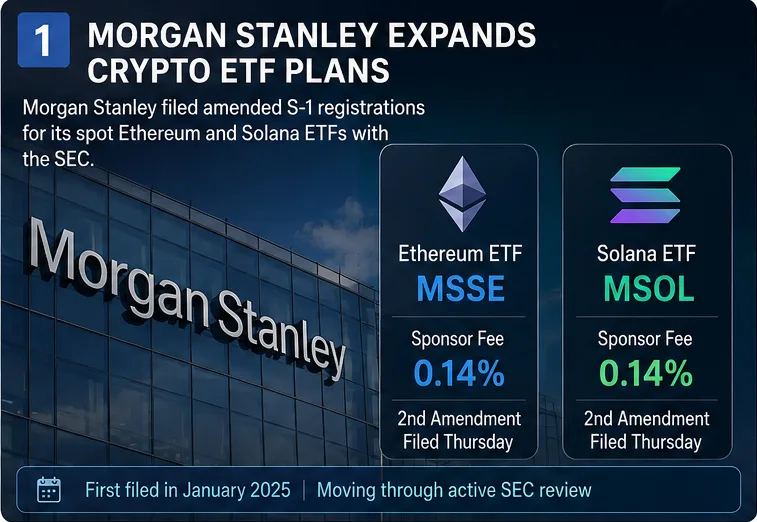
Morgan Stanley has filed new amendments for its proposed spot Ethereum and Solana exchange-traded funds, moving both applications further through the launch process after the bank’s recent bitcoin ETF debut.
The Wall Street bank submitted amended S-1 registration statements to the Securities and Exchange Commission on Thursday. The filings represent the second amendments for both the Ethereum and Solana ETF applications, which were first filed in January.
The latest amendments disclosed sponsor fees of 0.14% for both funds. If approved and launched with those terms, the fees would be the lowest in the U.S. spot Ethereum and Solana ETF markets.
The Ethereum fund is expected to trade under the ticker MSSE, while the Solana fund is expected to trade under MSOL. The added fee and service-provider details suggest the applications are moving through active review, with the issuer and regulator working through operational and disclosure issues before any potential launch.
Why Does the 0.14% Fee Matter?
The proposed 0.14% sponsor fee places Morgan Stanley below current low-cost competitors in both markets. Grayscale’s Mini Ethereum Trust currently offers the lowest sponsor fee among Ethereum ETFs at 0.15%, while Franklin Templeton’s SOEZ is the lowest-fee Solana ETF at 0.19%, according to market data cited in the source material.
Fee competition has become one of the clearest battlegrounds in crypto ETFs. Spot products often hold the same underlying asset, making price, brand, liquidity, custody structure, and distribution the main points of differentiation. A lower sponsor fee gives Morgan Stanley a direct way to compete for adviser platforms, institutional allocators, and cost-sensitive investors.
The strategy mirrors the bank’s approach in bitcoin ETFs. Morgan Stanley’s bitcoin fund launched in April with the same 0.14% sponsor fee, undercutting established spot bitcoin funds. As of June 18, that product had attracted $300.7 million in cumulative net inflows.
For Ethereum and Solana, the pricing decision may be even more important. Both markets are smaller than bitcoin ETFs, and flows can be more sensitive to early liquidity and distribution. A low fee can help an issuer gain attention quickly, especially if the product launches into a crowded field.
Investor Takeaway
Morgan Stanley is using price as an entry strategy across crypto ETFs. A 0.14% fee would pressure rival Ethereum and Solana ETF issuers and could push the next phase of competition toward lower costs, staking design, and institutional distribution.
How Will Staking Shape the Funds?
The amended filings also named Figment Inc., Galaxy Blockchain Infrastructure LLC, and Coinbase Canada Inc. as staking service providers. Morgan Stanley’s proposed Ethereum and Solana ETFs plan to stake a portion of their held assets to generate additional rewards.
The filings state that a 5% staking fee will be allocated to staking service providers and custodians. That detail is important because staking can improve fund economics, but it also adds operational and regulatory complexity. Issuers must explain how assets are staked, how rewards are handled, what fees are deducted, and how risks such as slashing, validator failure, liquidity constraints, or custody arrangements are managed.
For Ethereum and Solana ETFs, staking is more than an added yield feat
ure. It affects how closely a fund tracks the full economic return of the underlying asset. Products that stake may be able to capture rewards that unstaked funds leave out, although investors still need to account for fees, tax treatment, and operational risk.
The use of multiple staking providers also suggests Morgan Stanley is building redundancy into the structure. That can reduce reliance on a single validator or infrastructure provider, although final risk disclosures will remain central to investor review.
What Does This Mean for Crypto ETF Competition?
The amendments show that large financial institutions are continuing to expand crypto ETF offerings beyond bitcoin. Morgan Stanley’s bitcoin ETF has already entered the market, and the Ethereum and Solana filings point to a broader product lineup built around major crypto assets.
For competitors, the proposed fees raise pressure on pricing. Ethereum ETF issuers already face tight fee competition, and Solana ETF issuers may need to respond if Morgan Stanley launches at 0.14%. Lower fees can compress issuer margins, but they may also accelerate institutional adoption by making crypto exposure cheaper inside regulated fund structures.
The filings also show how the next stage of crypto ETF competition may differ from the bitcoin race. Bitcoin funds mostly compete on price, liquidity, custody, and brand. Ethereum and Solana funds add staking as a major variable, which gives issuers another way to shape returns and differentiate products.
For investors, the key question is whether low fees and staking rewards can offset the volatility of the underlying assets. The amendments mark progress, but approval, launch timing, liquidity, and final staking terms remain the main variables to watch.